

Type: historical, landscape, and cultural
Approximate distance: 44 km
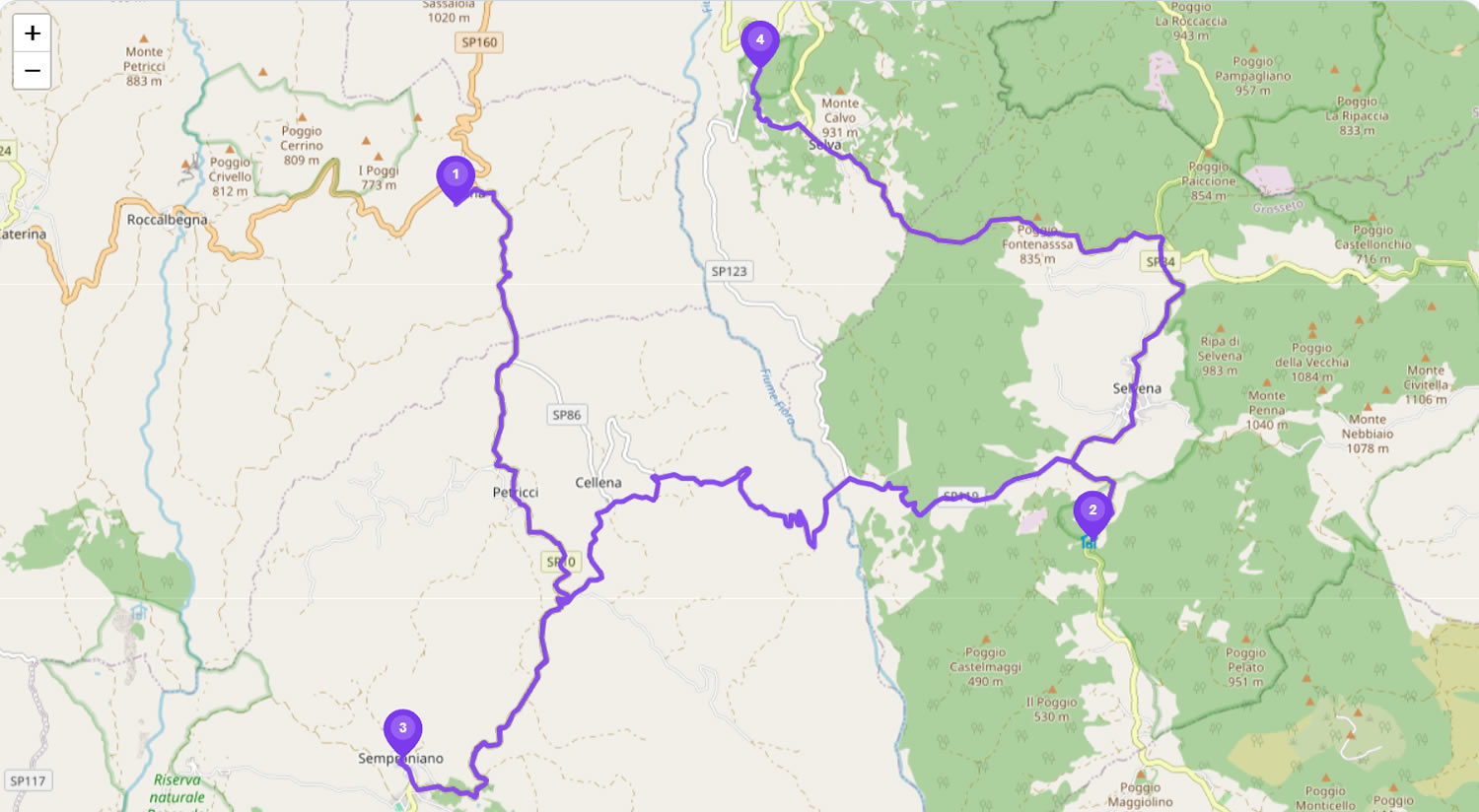
This time the proposed route crosses one of the most strategic and least explored areas of southern Tuscany, where the landscape has been shaped by the idea of the boundary: political, military, and natural, between Mount Amiata, the Maremma, and the tuff area. It starts from Santa Fiora, leaving behind the water and woods of the village to enter a harsher terrain marked by ridgelines, deep valleys, and fortified outposts.
🏘️ Triana: a village built for defense
Descending from the mountain, you reach Triana, a small village perched on a rocky spur. The settlement preserves a compact and clearly defensive structure, with remains of fortifications and controlled viewpoints over the surrounding land. Triana is a perfect example of a border settlement, where the shape of the village is dictated more by the need for protection than by expansion.
🏰 Semproniano: opening toward the Maremma
Continuing on, you arrive at Semproniano, a medieval village once linked to the Aldobrandeschi family. The remains of the fortress and its dominant position allow for a broader reading of the landscape: here the terrain opens up and begins to connect with the Maremma, marking the transition from mountain to softer, more open land.
🏡 Cellena: ancient traces and rural landscape
The itinerary continues toward Cellena, now one of the smallest hamlets in the area, yet significant for understanding the continuity of settlement. Nearby are traces of ancient occupation and sites such as Corte Vecchia, documenting Etruscan and medieval presence linked to agricultural management and resource control. Cellena also offers wide views over the valley and the Maremma countryside, marking the shift from fortified landscape to rural space.
🏰 Rocca Silvana: power, mining, and visual control
At the heart of the itinerary stands Rocca Silvana, one of the most imposing fortifications in the Amiata area. Of medieval origin and tied to the Aldobrandeschi power system, the fortress played a crucial strategic role: controlling the internal routes of the Fiora valley and the areas connected to cinnabar extraction, a key resource for the local economy.
From the fortress, spectacular views open over the valley, surrounding ridges, and the forests of the Selva: a privileged point to understand how sight itself functioned as a tool of territorial control. Restoration works have made the structure legible again, allowing a visit that combines military architecture and landscape.
⛪ Monastery of the Holy Trinity: the convent and the legend of the “Cifero Serpent”
In the heart of the forest stands the Convent of the Holy Trinity, a complex of medieval origin expanded between the 15th century and the Renaissance by the Sforza family of Santa Fiora. Built along ancient pilgrimage routes and immersed in a dense fir forest, it still retains a strong sense of isolation and symbolic presence.
The convent was also visited during the Lorraine period: a plaque recalls the visit of Grand Duke Leopold II of Tuscany in the 19th century, a sign of the importance this place held not only on a religious level, but also politically and territorially within the Grand Duchy.
The Selva is also linked to one of the most famous legends of Mount Amiata, that of the Selva Dragon (or Cifero Serpent). According to tradition, a monstrous creature terrorized the area until it was killed by Guido Sforza, who brought its head to the convent as proof. The relic, still visible today, is likely of exotic origin, but the story lives on as a symbol of the deep relationship between the forest, fear, and the need for collective protection.
🌲 La Selva: forest and imagination
The Selva area of Santa Fiora is one of those places where nature, history, and popular storytelling overlap almost naturally. The forest here becomes dense and continuous, almost isolating, introducing a different dimension of the territory, less connected to control and more to a direct relationship with the environment.
Why choose it
An ideal itinerary for those who want to discover castles, fortified villages, and panoramic viewpoints beyond the usual routes, reading the landscape as the result of military strategies, economic resources, and human adaptation. Perfect for those who love secondary roads and places that tell the story of a territory through fortresses, legends, wide views, and essential settlements, rather than through monumental landmarks.